
Why I Write (Reposted)
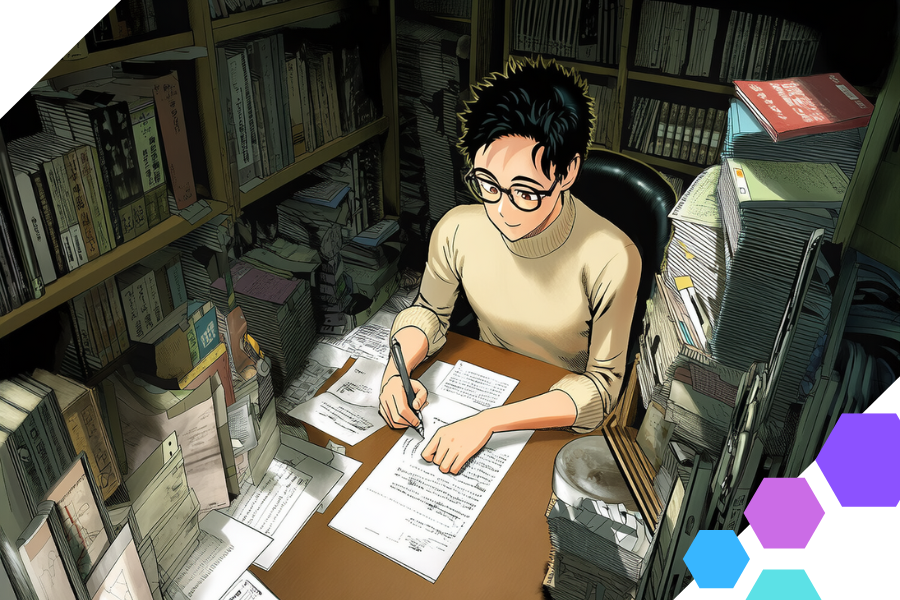
The Importance of Writing in the Digital Age
When I declare myself a writer, I am not stating my profession; I am describing my mission. When I declare myself a writer, I enlist in the war of ideas; I become a soldier. When I declare myself a writer, I make a commitment to humanity, integrity, and honesty. A writer transcribes the opaque broth of human consciousness into digestible prose, but why is this important? To what end do we do this? And with what means? This article will unpack the process of writing, how it has changed my life, and how it could change yours.
Writing is, for me, a treatment for a most egregious condition, stupidity, i.e. that my disposition tends toward ignorance, credulity, and cowardice. I am a young man, I know little, and of the little I know, my knowledge is poorly honed. I have absorbed ideas like a deep-sea sponge, many without questioning their validity, biases, or toxicity. Such are the perils of the information age, a digital overexposure to concepts, but comparatively limited mechanisms for appraising them. And in myself, I find cowardice. Sometimes I concede to fear, I flee from the hideous truths of the world, of myself, or of my feelings. These traits, enemies of maturity, obstacles to sagacity, are why I must write; for writing, though not the cure, is the medicine for these malefactions, the prescription for my prematurity of processing, and the treatment to my troglodyte tendencies in thought.
By this, I mean the inherent fogginess of my mind. In the digital age, we spend hours a day hooked up to a global information matrix alongside billions of others, we are bombarded with an unassailing assault of ideas, images, headlines, advertisements, and other stimuli. For me, this has led to a haziness of thought. It seems that my brain is unable to wrangle the data, so it festers in my mind as a muddled melange, a Gordian knot, complex, confused, and incomprehensible. Writing is the instrument by which I surgically unravel this tumorous knot. The pen—or in this era, the keyboard—is like a needle; it captures the tip of the bundle and embroiders it, turning a scribble into a string, then a string into a sentence, sentences into concepts, and concepts into a crystallization of consciousness. That is the nature of writing. Of course, one can only dream of thinking as elegantly as they write, not even in my wildest fantasies could my thoughts be this felicitous. But therein lies the beauty of writing, it is not only a stream of consciousness, but a purified one, a consolidated and remastered one, structured, ordered, and edited to make sense of the meandering mind.
I see my thoughts spread bare and naked on the page, and as one would judge a bodybuilding stage, I appraise their anatomy. Where have these ideas come from? Who let them in? Is there anyone working at border control? Moreover, which facts, feelings, or experiences have they been informed by? Are these ideas my own, or are they parroted from elsewhere? Why does an argument or belief appeal to me more than another, and to which part of my psyche does it appeal? Is it for the mission of the rational faculties, allied to truth and justice? Or is it vacuous and vapid, sustenance for the voracious ego? Perhaps it is both, or perhaps it is deceptive, or perhaps I have self-deceived and misplaced it.
But the method by which I interrogate these matters is writing. My train of thought consists of half-a-dozen carriages if even that, insufficient to bear the burden of itself, let alone manifest philosophical awareness. Without writing, my capacity for thought is limited to conscious memory; I can only juggle as many statistics and axioms as I can call to mind, and the structure to bind them is sloppy. Perhaps due to my inherent forgetfulness, or my shambolic disposition, thinking without writing is like trying to craft a sculpture using ice cream—as in, the thoughts fade away, melting from my awareness before I can create anything coherent, let alone nuanced or profound. But writing crystallises thought, gives it longevity, permanence to the ephemeral. Through this medium, my thoughts are sustained beyond their typical half-life of ten seconds, allowing them to mature, become more self-aware, clash with other ideas, and gain battle experience from doing so. It is through writing that the seeds of my ideas and subsequently, my identity, are watered; it is through writing that the blight of my self-ignorance is somewhat remedied, and it is through writing that my conceptual saplings blossom into trees. Writing gives, to perceptions and propositions, breath and prana, and I would go so far as to prescribe it beyond myself, and to all who perceive.
For if writing is a means for maturing ideas, then the mind that writes more often manufactures mature musings, and it is through that habit that the mind subsequently becomes itself mature. After all, Aristotle writes “we are what we repeatedly do”, so if we are defined by our habits, then the habit of maturing thoughts sculpts a mature thinker.
Aside from writing, listening, reading, and discourse likewise nourish the mind in some way or another. This, however, depends on the nature of the content and the nature of one’s approach to it. Some works are meant to inform, others to persuade, and others to inspire; although inevitably all works will have varied effects, many beyond their author’s intentions. Even a piece intended only to inform will have some persuasive property to it, be that in the way the facts are presented, or even the order they are presented in. And with regard to one’s approach, I refer to the fact that we do not digest books in the same way. Some minds have a sceptical disposition and will challenge any content they are presented with. For these minds, reading has an inherently dialectical element as foreign ideas clash with one’s own beliefs. Other minds, those of lax epistemology—like my own—can be naive and gullible and will trust whatever they read or hear, taking it at face value. Aware of this, I should be careful with what I read, for my opinions have proven to be malleable and unfixed. I want to believe everything I see or hear, that is my disposition. Exposure to malicious or malformed ideas, therefore, is particularly dangerous to me, and the internet, where I spend a significant portion of my waking hours, is swarming with them. To my mind, it is perhaps the most hazardous place to be. From years of careless internet use, I have soaked up a dangerous dosage of defective ideas, and I can neither calculate nor fathom the extent of the damage it has dealt to my worldview.
And therein lies the gravity of the situation. I believe that one’s worldview is one’s world, i.e. that your perception is your reality. And so, if the ideas of the internet are corrupting my perception, they are subsequently invading my reality. Bad ideas, therefore, are not a petty problem insofar as they are, to me, an existential threat. In Daniel Kahneman’s book, Thinking Fast and Slow, he reveals to us that humans, as rational as we think we are, as rational as we try to be, tend toward irrational heuristics. We oversimplify, we use biases, and
we are swayed by the gravity of our moods and emotions. Most significantly, on topics of cognitive dissonance, i.e. uncertainty, we have a higher tendency to conform to what is familiar on a much deeper level.
This is particularly problematic due to the state of civilisation. We live in an era of unhinged political conflict, economic imbalances, gender wars, matters of sexuality and religion, etc. The radioactive fallout from this nuclear culture war has left a blizzard of cognitive dissonance across the modern zeitgeist. Furthermore, in many arenas the battles between ideas have become tribal and animalistic, and that attitude irradiates others—it harpoons rational, independent thought wherever it arises, and drags it down into the inferno of political tribalism. The internet is a dangerous place, and I have found myself caught and dragged into various tribes across the political spectrum, especially in my teenage years: BLM, feminism, and like many young men, I even had a MGTOW phase. This was a result of the internet’s proclivity to generate ideological echo chambers, a property exacerbated by the cognitive dissonance of the aforementioned complex social issues.
As we know, the internet, especially social media, is not made to enlighten you, but to ensnare your attention. It will feed you what you are most likely to consume, rather than what is genuinely good for you. Over the recent months, I tried to start a career in digital marketing, and to do so I began learning how to use Google Analytics. I witnessed firsthand what online marketers are paid to do. The key statistics are not only how many clicks you can get, but how many times you are seen, how long is spent on your website, and how much engagement time is spent there. Digital marketers are paid to analyse what you look at on their sites and optimizing them accordingly. I imagine successful social media algorithms, e.g. TikTok, Instagram and YouTube do the same to a much higher level. If you are likely to click on “YAAS Queen, #girlboss” videos, the internet will direct you to other content, comment sections, and online communities perpetuating that attitude, and it is the same when someone clicks on “Feminists get rekt” videos. When I was a teenager, I had no epistemological tools to defend myself from these ideologies, and this is how I wound up roped into various political tribes for a time.
An example of this is my MGTOW phase, I’m not proud of it, but I see the same happening to adolescent boys today with Andrew Tate and the Manosphere. Because I attended an all-boys school, the opposite sex was a mystery to me. The only times I would hear about girls were when boys talked about hooking up, getting roped into relationship drama, or being cheated on and heartbroken. At the same time, my internet feed was inundated with videos of raging red-haired women behaving barbarically under thumbnails about “feminism”. Due to my unfamiliarity with girls, I filled the void of ignorance with whatever I was repeatedly exposed to. And unfortunately, this depicted them in an unfairly negative light. Luckily, the same malleability of mind that got me into that mess also got me out of it. But it pains me to see the same happening to other people. In my second year of higher education, a woman, an alumnus of Durham University, befell a horrible fate, and the perpetrator was male. An acquaintance of mine, Ms X, wrote an impassioned letter in response. And though I think she meant well, when I read the letter, I saw the same inklings of reactionary outrage permeating political tribes. It was not overtly misandrous, and I agreed with the individual talking points. The problem was not with what was said, but how it was said.
Though the letter was presented and framed as a message demanding positive change, it was dripping with venomous undertones, particularly, what I felt was an "us vs them" narrative. I did not find the letter offensive, nor did I get defensive of men, that would have been counterproductive at the time—I vaguely understood the situation enough to hold my tongue. Somebody of her tribe had been killed by somebody of mine, and in the passion of the moment, that was her response. But how can I think less of her for it? I might have done the same had it been one of my tribe… if I had not seen her do it first. I remember a similar occurrence following the murder of George Floyd, and when the crime rate against Chinese people skyrocketed during the COVID lockdown. For ethnic reasons, the Chinese are something of my own tribe. Though I do not associate with them completely, seeing the Black- on-Chinese crime rate rise in the US was nonetheless somewhat personally offensive. However, unlike Ms X’s letter, I decided against engaging in that political turmoil—I think part of me understood that my vision was too clouded to do so at the time.
The moral of the story is to be wary of ideological tribes and how the internet's outrage culture tends to herd stray thinkers toward them. And though I may agree or disagree with various political groups on their premises, I abhor the attitude of political tribalism, a poison to modern discourse. The issue is, the majority of today’s youth (including myself) dwell on the internet, the internet promotes tribalism, and tribalism is the enemy of nuanced, humane, and mature thinking. Because a significant portion of my existence is digital, I must also write to prune my thoughts and reflect on what I have absorbed, both the good and the bad. And for that same reason, assuming that others can use it the same way, I believe that writing is a more important activity than ever before. Note that I call it an activity rather than a skill because it is the process that matters, not the product. Writing and its various subroutines: editing, proofreading, comprehension, rationalisation, grammar, logic, emotional intelligence, self-expression, and rhetoric, are essential arms in the war of ideas—and whether your mind will be conquered, defend itself, or conquer others, depends on how practised you are with these faculties and how you choose to deploy them.
This message goes to everybody, but especially to those of us born in the early twenty-first century. Gen Z, my contemporaries, are among the first to grow up in the digital age, and the last to remember the world before smart devices took over; perhaps that is why we are named after the end of the alphabet, we are the last people to live in the “real” world. What comes next appears to be a mass digitalisation across all aspects of life. Generation Alpha, our immediate successors, the children of today, will be the first to grow up never knowing a world without smart devices. They will be familiar with AI and the internet from a very young age, and that is potentially disastrous if not handled carefully. Children have almost no sense of epistemology, and though I do not wish to berate their intelligence, they are definitely immature. I have described what I went through as a teenager, but I received my first smartphone at fifteen or sixteen. Today, children as young as five or six are using smart devices and have the savvy to surf the World Wide Web. Given what I have experienced of the internet, I know it to be a pathologically overstimulating environment, whirling with distractions, and littered with potholes into ideological echo chambers. It is a dangerous place for any human mind to be, let alone a young and vulnerable one.
As a member of Gen Z, I am aware of how our motivation and attention spans have atrophied, particularly as our digital dependence exploded throughout the COVID lockdowns. Years later, I am only now attempting to reclaim control over my mind. Most concerning of all is our aversion to boredom. Many of us have developed a habit of retreating online to escape the mundane; this behaviour worsened during lockdown and has persisted until today. And by this, I do not always mean full immersion, e.g. scrolling on Instagram or watching YouTube Shorts, it could be having a podcast playing in the background, or streaming music on Spotify. These days, I rarely find myself alone with the silence of my mind except for when I am writing. I imagine that the overdose of digital dopamine over recent years has taken a toll on my cognitive capacities; it has corroded my concentration as smoking would on lung capacity. Prominent neuroscientist Andrew Huberman often cites studies discussing the limited production of dopamine and that it is possible to exhaust one’s supply or become inured to it under extreme conditions. Chronic digital overstimulation is such a condition, I call it a “CDOS attack”, and it is entirely self-inflicted with severe neurological symptoms. I imagine, if you are reading this, you have experienced something similar, perhaps to a lesser extent, perhaps even more so; but if the effects are this noticeable to us, I wonder how radically they will impact Generation Alpha. The children of today experience this digital exposure from a very young age, the critical period that which the human brain has its greatest plasticity, and I worry that this will have major effects on their mental and neurological health as they mature. Only time will tell.
But the attack on our attention spans is only one symptom amidst many. Equally, if not more concerning is a phenomenon American brain coach, Jim Kwik calls “digital dementia”. This is defined as the decay of a cognitive function due to outsourcing faculties of thought to smart devices. Kwik uses the example of how people used to memorise their passwords and phone numbers, but nowadays, we do not—only a few essentials. We used to navigate using geospatial intelligence, landmarks, or maps—but now we rely on GPS technology and smart maps. A personal example is how I used to memorise information, but now I tend to memorise where the information is sourced, and how to access it digitally, e.g. the website name, the search query, or the location of a screenshot on my phone. But of all the cases this is happening, the truly concerning prospect, in my view, is people outsourcing their critical or creative thinking to AI.
During my final year at university, ChatGPT Model 3 had just entered the mainstream. Students were—for the first time—trying to use it to generate their essays and CVs. I did not think much of it at the time; I thought it was a novel method of student laziness, but upon further reflection, it could be the root of an oncoming catastrophe. A university essay is meant to be a trial, a trial of thoughts and ideas subjected to criticism in an academic format, and a CV is supposed to be a compressed career biography. In these scenarios, the use of AI disturbs me deeply. Why? Because it marks the next stage of digital dementia, much more dire than the aforementioned examples. Perhaps we have no intrinsic need to memorise sequences of phone numbers, but I believe it is essential that we can manifest and structure our own thoughts—and if outsourcing this ability to artificial intelligence becomes common practice, we will have a generation of people who have forgotten how to think for themselves and rely on AI to do it for them.
And I am not innocent of this myself. Though not a single word of my dissertation was written by AI, the first draft of its structural blueprint was generated by GPT-4. I am also writing a novel, and occasionally experience writer’s block. I have had times of weakness where, in my frustration, I have turned to generative AI to get unstuck. So far, nothing egregious has come of this, and the most I have ever used from AI in my fiction is a brief, isolated snippet of character dialogue. Even so, the fact that I allowed myself to do this is the very tip of a slippery slope. I believe that I am someone who cares about free thinking and human creativity more than the average person—and so, if I can be tempted, I believe many will fall, especially as generative AI becomes more powerful, more advanced, and holds more tokens of information.
But what does that fall look like, a world where most people outsource their critical faculties to AI? Perhaps I am a pessimist. My mind resorts to a dystopian nightmare. I see a world where we are informed by internet trends, addicted to digital dopamine, and incapable of independent thought, and I imagine our jobs have been outsourced to robots and computers by this point. In fact, some of the aforementioned conditions have already manifested. I struggle to see how our society would function. For most of human history, people have been the means of production, whether in a slave state like Sparta or on the conveyor belt of an industrial age factory. People have also been the conduits of military force,
e.g. the Macedonian phalanx, the Mongolian horse archer, or the Ottoman janissary. If what Mao says is true, that political power grows from the barrel of a gun, then there has always been an element of democracy, at least for the people who hold the guns. But what if the guns are no longer in human hands? What if automated drone warfare becomes the standard, and our battles are fought by machines? In a world of mechanised militaries, who has the power? The machines? The manufacturers of the machines? The shareholders of the corporations that manufacture the machines? Certainly not the average civilian.
If we are no longer the means of production and no longer the conduits of military force, then what purpose do we serve in civilisation? For the powers in charge, would there be any need to keep us happy? It’s not like we can rebel against an AI-powered mechanised military. And if we unionised the workers and went on strike, it would be futile against a production force of AI and robots. Then has humankind lost its purpose? What is there to do? In this scenario, I can see something akin to Robert Nozick’s pleasure machine, a world where reality has become so meaningless and barren that everyone retreats to the virtual realm in pursuit of their daily dose of dopamine, enslaved by a pathology of digital hedonism. I can see a world run by globalist technocratic corporatocracies, with everyone else living under techno-feudalism. I don’t know what the future holds, but seeing as the legislation cannot keep up with the rapid developments of AI, the middle class is shrinking, and normal people are owning less and less, seeing how much political power is projected by unelected corporate entities, and that the western world is distracted by personal matters of gender and identity… I see a world where we, as a species, specifically my generation, politically apathetic, financially broke, and chronically misinformed, would enable this dystopia to become our reality. I am not pessimistic enough to claim this is our destiny, but I am disturbingly confident that, should we fail to take the time to think, such a future is possible. The seeds of this dystopia have already been planted.
But perhaps, to you, my predictions are unreasonably bleak. I may even agree with you depending on my mood or my recent reading. The future I have described is but the abyss I see at the bottom of a slippery slope, the collapse of humanity deeper into the digital age. I specifically describe it as a “collapse” because it is not a controlled descent. We do not even know who is piloting the plane, so I doubt there will be a happy landing. One could also liken our situation to that of a glacier under the summer sun, in the sense that the cultural, political, moral, and economic foundations of our society seem to be melting, and the ripples when it falls will scour the world as deadly waves. But in keeping with the reflective nature of this article, my attempts at cultural analysis shall be spared for another time. My point is, as a civilisation we do not know where we are, who we are, nor where we are headed—but we need people who care enough to think about it and dare enough to write about it.
That is, to dare to engage in the war of ideas, as ugly as it has become. To refuse to do so, to retreat, means to abdicate one’s place in human history. We should be politically or philosophically engaged, at least enough to independently interrogate our surroundings, and I understand that this is not easy; it can be exhausting, especially in a world where many are chronically fatigued with work or family obligations. After all, where does one have the time to discuss economics when it is taking all that they have to make ends meet through the cost-of-living crisis? We have little energy left to consider the conditions of our survival and the bigger picture. Given this state, it is much easier to subscribe to a political tribe and inherit a bundle of set beliefs, to concede your agency to the horde. But this is not genuine engagement; it is superficial. Of the members of political tribes, I wonder how many truly understand the ideologies they are subscribed to. I’m sure some do, but many do not. But to those caught in this mindset, I do not berate you; I understand the temptations of tribalism, it paints a mark on the enemy and highlights its allies, it sets a standard of right and wrong, and it makes things easier and simpler. But “easy and simple” does not map onto reality; annoyingly, the world is far too complex, and morality is frustratingly grey. We should not see with binary vision: friends or foes, left or right, good or evil, democrat or republican, labour or conservative, communist or capitalist, to see the world in this way, black or white, is a low- resolution image. And though it requires more processing power to do so, to see the world in high definition 4K 3D Blu-ray, to have a clearer resolution on reality, we must abandon our cookie-cutter ideologies and form our own thoughts on a case-by-case basis. It is a perilous task; outrage culture and cancel culture have polluted the battlefields of the war of ideas, but we must continue to cultivate our thoughts, lest we let thoughtlessness win. That is why we must fight, and that is why we should write.
And though it would be audacious, even for me, to say that we can just write our woes away, there are axioms to my argument reasonable enough to consider. Let us revisit some of them. Firstly, that the act of writing enables a maturity of thought, and that the habit of maturing one’s thought refines one into a more mature thinker. This makes us armed and dangerous in the war of ideas. Secondly, elements of the digital age, e.g. the internet and generative AI, as beneficent as they are, cannot be denied as threats to our maturity of thought, specifically cancel culture, outrage culture, digital distractions, and the threat of artificial intelligence replacing organic intelligence.
Thirdly, mature thoughts are morally and pragmatically favourable. To argue this, I must outline the qualifications for a so-called mature thought. For a thought to be mature, I believe it must leave the constraints of conscious memory, and the easiest way to do this is to transcribe it into writing. As conscious entities, we do not always understand what goes on in our heads or in our hearts; this is evidenced by the existence of counselling and therapy services. When we describe our nebulous inner worlds via writing, it is like taking a snapshot of one’s soul; the act is fundamentally therapeutic. However, it is the subskills of writing that bring the process full circle: comprehension, rationalisation, reflection, proofreading, and editing. The application of these subskills is where our thoughts are matured. Comprehension, for example, is the ability to understand what you have written; it is a means to understand your thoughts, how they are arranged, and how they interconnect. Rationalisation is the next step up—I call this stage “meta-comprehension”, it is when one inquires beyond what their thoughts are, but why they are the way they are, where they have come from, and which personal biases may distort them. In essence, it is when comprehension goes beyond face-value content and explores the nature, origin, and purpose of the prose.
The third step, reflection, is not specifically a writing skill, but one that complements the latter two. Reflection is when a reader understands what they have written, the nature of what they have written, and reverse-engineers that data to reconstruct a concept of oneself. This is like asking the question: “What can a sword tell you about the smith?”. Reflection is when one gathers their written thoughts and finds patterns in them. Then, using these patterns, the mind can paint a portrait of itself. Of itself, the mind asks: “What kind of mind produces thoughts like these?”, and thus begins a journey of self-discovery. Note that I describe it as “painting a portrait” rather than a “simulation” or “replication”; this is because the mind, though it appears to be a static concept, is fundamentally dynamic, for when it is not in motion, it does not exist. I use the word “portrait” because it is interpretive, a still frame captured of an ever-moving subject, but it does not capture the motion.
The other featured subskills, proofreading and editing, are when the mind loops around and re-examines itself, often with the clarity of hindsight. Proofreading is the process of checking for errors, not only in grammar but in logic or data. In other words, when done unto oneself, it means the recognition of one’s mistakes, marking them for editing. Editing, then, is the correction of one’s mistakes, but not only that, the restructuring, rephrasing, and rewriting of one’s ideas, making them more felicitous, sincere, or true, and aligning them to their purpose. To do this, one must have the writing’s purpose in mind. It necessitates an understanding of one’s intentions and harmonises what one thinks with what one wants. I believe that these stages are somewhat discursive, that they are what happens when a mind talks to an echo of its former self, when the dynamic, present mind collides with the static, crystallised mind. When the process is repeated, it sculpts the thought, giving it clarity and definition. When I talk about mature thoughts, this is what I mean: it is a thought that, through many collisions from all angles, countless strikes of the cognitive hammer and chisel, countless corrections, contortions, and corroborations, has at last become a masterpiece.
Mature thoughts, therefore, are more likely to be well-balanced, nuanced, creative, tangible, and rational, and these properties are normatively favourable. Of course, there is the inevitability that bad actors will use writing as a means to cultivate malicious ideas, but I do not think this is a serious problem for the honest, self-aware mind. I believe that, as an idea is developed, it becomes less likely to be excessively maleficent. This is because maliciousness and maturity somewhat contradict. For a maleficent idea to become mature, it would need to have passed several cycles of the aforementioned process; for such an idea to survive would require potent justification, and by the time it reaches maturity, it would be somewhat declawed and neutralised. Maliciousness and sadism are primitive in nature, so as an idea matures, what was once senseless spite becomes pragmatic and necessary evil— nothing can be mature without being meticulously considered and extensively justified. For this reason, on the spectrum of the development of ideas, the undeveloped end holds the majority of destructive and problematic ideas, whereas the mature end tends toward beneficent and logically consistent ideas.
This being the case, let us be idealistic and unrealistic for a moment. If we were to transpose this trend onto wider humanity, i.e. if everyone used writing as a means of cultivating thoughts, it follows that the collective corpus of cognition would sway away from ill-considered cookie-cutter thoughts and evolve into well-informed, honest, and tangible ideas. By tangible, I refer to ideas with clear premises and structure, ideas that are easy to interact with, whether elaborating on them or criticising them. These tangible ideas will promote civil discourse, mutual understanding, and empathy across the world. But as idealistic as that is, my claim is nothing profound; I simply posit that the world would be a better place if everybody thought in a more mature and empathetic way, and my main argument is that writing is a vehicle that could take us there.
To conclude, let us review all that has been discussed and bind it together. I begin with a personal account of how I use writing as a means to counteract my stupidity. I then explore how writing facilitates mature thinking, and how the perils of the digital age, e.g., the internet and AI may perpetuate thoughtlessness and empower political tribalism. I discuss how the digital world is riddled with distractions and outrage culture, and that it is a dangerous environment for maturing minds or growing ideas. I also express concerns that AI threatens to take not only our jobs but our capacity for thought—and that humans are likely to concede these faculties for the sake of convenience. I then take a detour to describe a dystopian nightmare, a world where nobody thinks, and technology takes over, I express my concerns for the future, and encourage anyone who is living through this pivot point in history to write about it—that way, whether we fix this mess or the world goes tits up, at least our successors can understand why. I then raise a call to arms, summoning anyone and everyone to partake in the war of ideas, and that we should take up pens rather than swords to do so. Finally, I examine the process of writing and how it cultivates good ideas, and I argue that good ideas will bring us to a brighter future and a better world.
Having summarised my thoughts, it seems that, ultimately, the topic of the day is not the act of writing, but what it facilitates: thinking. We want to live in a better world, but we can only get there through better actions, better actions informed by better thoughts, and better thoughts enabled by writing things down. I know that few who read the headline remain at the tail end of the tale, but to those who have managed to get here, I thank you for your attention. To the dear readers who remain, who have understood or resonated with this piece, if even one of you has gained the inspiration to write, then you have made a success of my work.
All the best, and happy writing.
